- by families worldwide
Irish sticks when children hear it in contexts they do not associate with effort. A vocabulary list on a screen teaches words. An app where Irish is simply how everything works — the instructions, the prompts, the encouragement — builds something closer to instinct. That is the difference worth looking for.
Irish occupies a strange position. It is an official language of Ireland, taught in every school, present on road signs and government forms. And yet outside the Gaeltacht — the pockets of the country where Irish is the community language — most children finish school with a passive relationship to the language at best.
For diaspora families and for Irish families outside the Gaeltacht, the challenge is even sharper. Irish has no Netflix library, no dominant social media presence, no major app store category to browse. The infrastructure that keeps languages alive in children’s daily lives — media, entertainment, digital tools — is overwhelmingly in English.
This means parents who want Irish to stick have to be deliberate about every point of contact. School Irish is not enough. Weekend classes help but are not enough on their own. What makes the difference is finding ways to get Irish into the normal flow of a child’s day — in play, in games, in the background. An app that does this quietly and consistently is worth more than occasional intensive sessions.

Retention comes from repetition in varied contexts. A word heard once is forgotten. A word heard in a counting game, then a colouring activity, then a matching challenge, then a spelling task — across multiple days — begins to settle. Here is what to look for:
What separates apps that build Irish language learning from those that just expose children to Irish words is immersion over time. One session is not the point. The accumulation of sessions is.
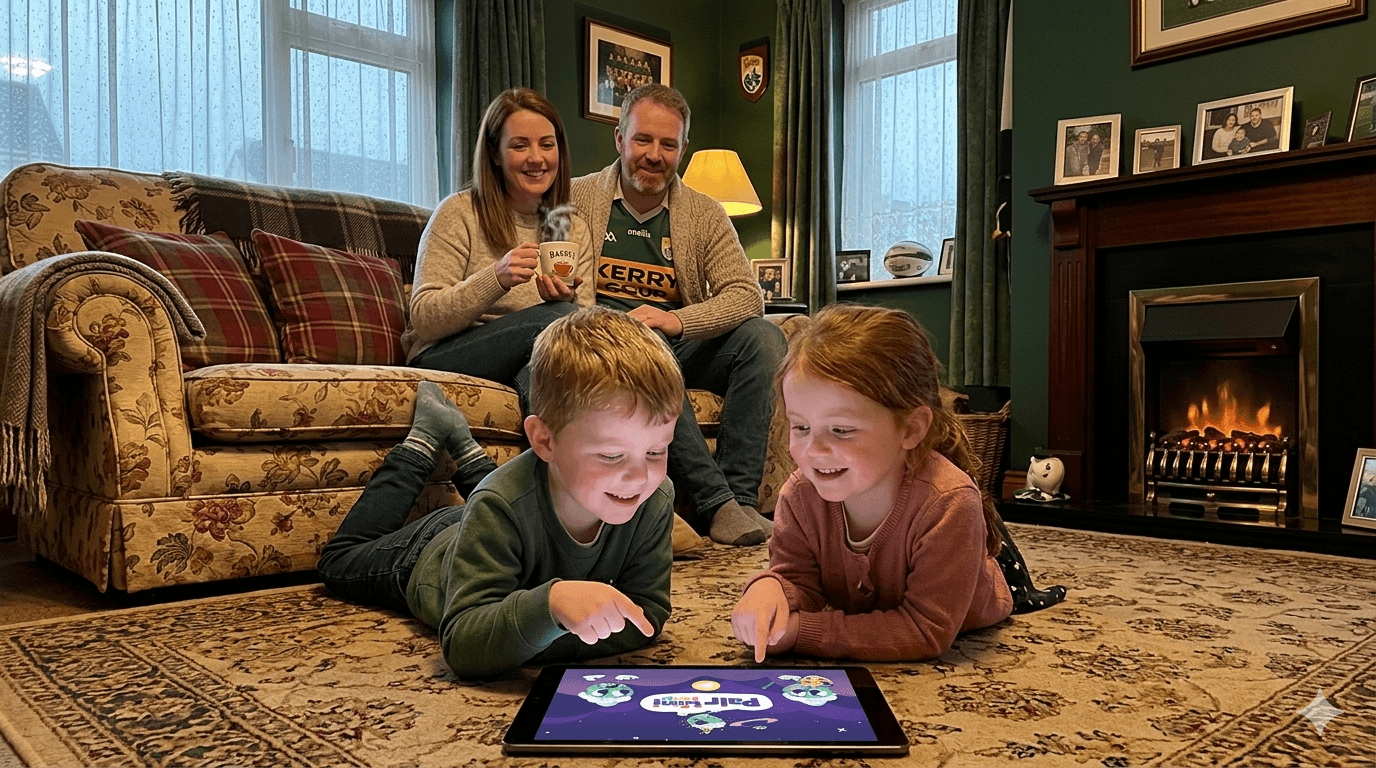
Parlini Land includes Irish as a core language — not an afterthought. Select Irish and the entire app operates in it. Your child hears Irish in a tracing game, then a colouring activity, then a counting challenge, then a matching game, then a spelling task. Different formats, same language, building up across every session. The voiceovers are real human recordings, not AI. The design is calm and built for ages 3–6.
The app is teacher-approved and used by families across Ireland, the diaspora, and by parents whose children attend Gaelscoileanna. It does not replace speaking Irish at home or in school. But it gives the Irish a foothold in the part of the day most likely to default to English — screen time — and that is where the battle for language retention is often won or lost.
If you are looking for an app that gives Irish a daily presence in your child’s life — not just an occasional lesson — Parlini Land is worth trying.
Does Parlini Land work for Gaelscoil children?
Yes. Because Parlini Land operates entirely in Irish, it complements Irish-medium education rather than working against it. It reinforces vocabulary and listening skills in a play-based format that children can access outside school hours, at home, without any English fallback.
How do I make Irish stick for my child at home?
Consistency beats intensity. A short daily interaction with Irish — even 10 to 15 minutes — is more effective than one long weekly session. Build Irish into existing routines: mealtimes, bedtime, screen time. An app that runs entirely in Irish turns screen time from a loss for the language into a gain.
My child understands Irish but will not speak it. Can an app help?
Passive understanding is a strong foundation — many children go through a silent period before they begin producing a language. Continued listening exposure, in varied and enjoyable contexts, is exactly what supports the transition from understanding to speaking. An app can be a low-pressure way to extend that exposure.