- by families worldwide
Every parent wants their child to feel confident with letters — not stressed by them. Uppercase and lowercase recognition is one of those early literacy steps that can either click naturally or become a source of frustration, depending on how it is introduced. The good news is that with the right approach, most children get there faster than you’d expect — and they enjoy the process.
It is easy to underestimate this step. Your child already knows the alphabet. They can sing it, they can point to letters on a page. So why does it still feel like A and a are two separate things to them?
Because, visually, they almost are. Uppercase and lowercase letters do not just differ in size — many of them are completely different shapes. A capital G and a lowercase g share a name and a sound, but they look nothing alike. For a young child who is still building their visual memory, recognising both forms of the same letter across different contexts — different fonts, different sizes, different words — is genuinely hard work.
This is not a sign that your child is behind. It is a normal part of how early literacy develops. And it is exactly the kind of thing that responds well to gentle, repeated exposure — not pressure, not drilling, not flash cards held up at the kitchen table while your child squirms.
Children aged 5 and above are ready to work on letter recognition in a more focused way than younger children. But ready does not mean they learn best through formal instruction. At this age, children still acquire knowledge most naturally through play, repetition, and low-stakes exploration.
A few things tend to work well:
What tends to backfire is introducing pressure too early. Testing before a child has had enough exposure creates avoidance. They begin to associate letters with getting things wrong, and the thing you most want them to enjoy becomes the thing they most want to avoid.
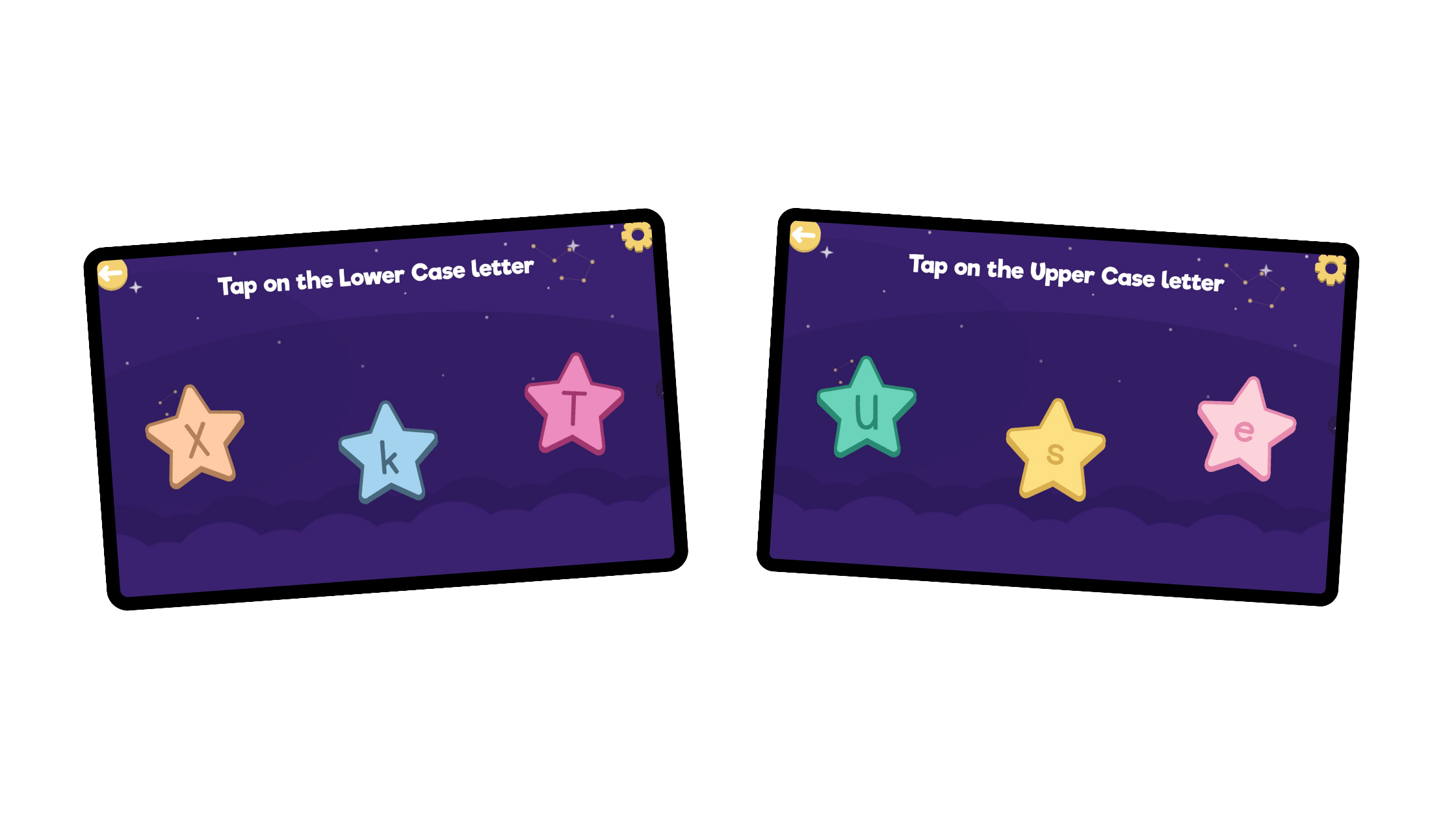
This is exactly the kind of learning that Parlini Land’s Uppercase or Lowercase game was designed for — the quiet, consistent, low-pressure kind that builds confidence without your child ever feeling like they are being tested.
The game works simply. A letter appears on screen. A real human voice — warm, clear, natural — gives your child a prompt: uppercase or lowercase? They tap their answer. If they get it wrong, there is no penalty, no discouraging sound, no strike. They simply try again. The game moves at your child’s pace, not the other way around.
What makes this particularly effective is the listening element. Every round begins with a spoken prompt, which means children are not just looking at letters — they are hearing letter names spoken naturally, building the connection between sound and symbol that sits at the heart of reading. It strengthens letter recognition and listening skills at the same time, in the same session, without your child needing to know that is what is happening.
The game is available in English, Greek, Spanish, Irish, Italian, French, German, Polish, and Swedish — which makes it genuinely useful for multilingual families. A child learning to read in more than one language can practise in both, hearing letter names as they are naturally spoken in each language. The literacy work and the language exposure happen together, without switching between apps or contexts.
Parlini Land sees this as a complementary approach to what children are already learning at school. It is not a replacement for classroom reading time or one-to-one practice with a parent. It is the thing that runs quietly in the background — reinforcing the same letter forms and sounds your child is already working on, in a format they will actually choose to return to.
If your child is at the stage where uppercase and lowercase letters are starting to matter — and you’d rather build that confidence through play than pressure — the Uppercase or Lowercase game is worth exploring.
Start a free trial today by clicking here!
What age should children start learning uppercase and lowercase letters?
Most children begin recognising letters between ages 3 and 5, but focused work on the distinction between uppercase and lowercase typically suits children aged 5 and above. At this stage they are ready for more deliberate letter recognition practice — especially when it comes through play and listening rather than formal instruction.
Why does my child know the alphabet but still confuse uppercase and lowercase letters?
Because knowing the alphabet and recognising both forms of every letter are two different skills. Many uppercase and lowercase versions of the same letter look completely different — g and G, a and A, r and R. Children need repeated exposure to both forms across different contexts before the connection between them becomes automatic. This is completely normal and very common at age 5.
Is the Uppercase or Lowercase game available in languages other than English?
Yes. The game is available in English, Greek, Spanish, Irish, Italian, French, German, Polish, and Swedish. In each language, the voice prompts are recorded by real human speakers, so children hear letter names spoken naturally in their home language — strengthening both letter recognition and listening skills at the same time.