- by families worldwide
It is one of the questions bilingual parents ask most — and feel most uncertain about. Is my child ready for letters in a second language, or will it confuse them? Will it slow down their reading in English? Are we doing too much too soon? The reassuring truth is that most children are more ready than their parents realise — and the window for getting started is wider than the anxiety suggests.
There is a very common — and very understandable — concern among parents raising bilingual children: that introducing letters in a second language before the first language is fully consolidated will create confusion. The child will mix up letters, slow down, or lose confidence in both.
This concern comes from a good place. It comes from paying close attention to your child and not wanting to push them into something they are not ready for. But the research on bilingual literacy development tells a more reassuring story.
Children who are developing literacy in two languages do not typically experience confusion — they experience a different kind of learning. They build two sets of associations simultaneously, and where the two languages share letter forms (as many European languages do), the recognition skills transfer. Learning that A is uppercase and a is lowercase in English also teaches it in French, in German, in Spanish. The child is not doing twice the work. They are doing the same work with wider application.
There is no single age at which second-language letter learning becomes appropriate — it depends on the child. But there are signs that a child is ready to begin, or is already naturally curious about it:
What is not on this list: fluency in the second language. A child does not need to speak a language confidently to begin recognising its letters. Literacy and spoken fluency develop alongside each other, not one after the other.
One of the practical challenges of second-language letter learning is finding a tool that delivers the letters in the right language, with the right sounds, without requiring a parent who is fluent in that language to be present for every session.
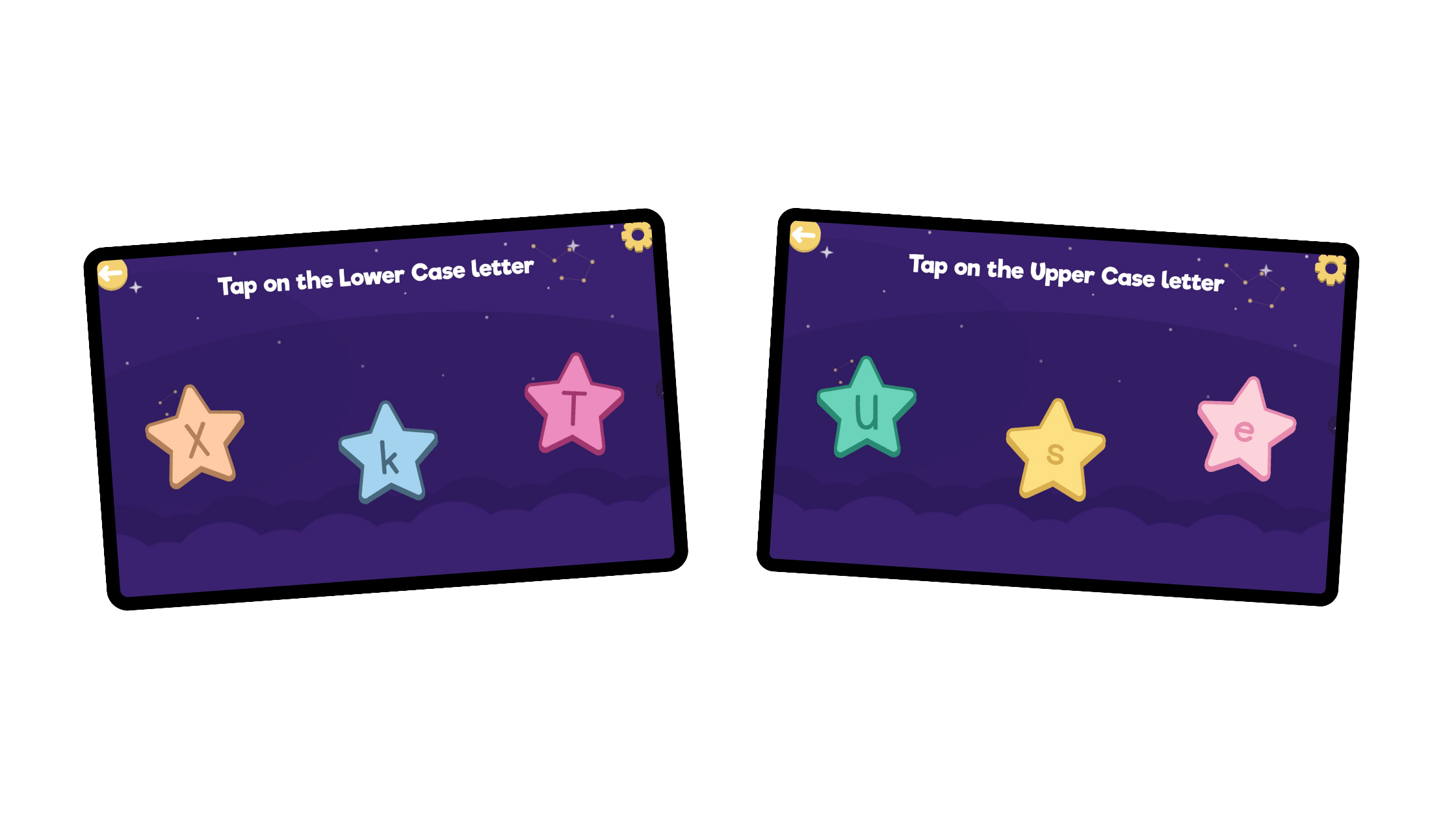
Parlini Land’s Uppercase or Lowercase game addresses this directly. The game is available in English, Greek, Spanish, Irish, Italian, French, German, Polish, and Swedish — and in each language, the prompts are voiced by real human speakers. When your child plays in Greek, they hear a natural Greek voice asking about Greek letters. When they play in Irish, they hear Irish. The experience is not translated from English. It sounds like the language it is supposed to be.
This matters more than it might seem. Young children are extraordinarily sensitive to whether a voice sounds authentic. A stilted or synthetic voice in a second language does not just feel slightly off — it teaches children the wrong sounds, the wrong rhythms, the wrong sense of what the language should feel like. Real human voices, in real accents, are what build genuine language and literacy connection.
The game is designed for ages 5 and up, with gentle prompts and no-penalty mistakes — which means children can explore a second language’s letters at their own pace, without the pressure of performing correctly. For bilingual families, it is one of the quieter but more effective tools available: a daily few minutes of second-language letter recognition, in a format children choose to return to on their own.
Can children learn letters in two languages at the same time?
Yes, and many children do so successfully. Where two languages share letter forms — as many European languages do — recognition skills transfer between them, meaning children are not starting from scratch in the second language. Even where letter forms differ, young children’s brains are well equipped to build separate sets of associations without significant confusion.
Will learning letters in a second language slow down my child’s reading in English?
Research on bilingual literacy development does not support this concern. Children who develop literacy in two languages simultaneously — or in close succession — do not typically fall behind in either language. In some areas, bilingual literacy experience has been associated with stronger phonological awareness overall.
What age is best to start letter recognition in a second language?
Around age 5 is a good starting point for focused letter recognition work in a second language, though children who have been immersed in the second language from birth may be ready earlier. The key signal is not age alone but whether the child is beginning to recognise letters in at least one language and is curious about the second.