- by families worldwide
Nouns, adjectives, and verbs. Three words that can send a parent straight back to their own school memories — grammar lessons, underlining exercises, getting things wrong in front of the class. It does not have to be like that for your child. In fact, the earlier children encounter these concepts — and the more casually they do so — the less intimidating they become. Here is what parents need to know.
Before thinking about when children should learn these, it helps to be clear on what they are — in the simplest possible terms.
A noun is a name. It is the word for a person, a place, a thing, or an idea. Dog, teacher, park, happiness — all nouns. If you can put “the” in front of it, it is almost certainly a noun.
An adjective is a describing word. It tells you more about a noun — what it looks like, how it feels, what kind it is. Big, red, loud, friendly — all adjectives. They are the words that make sentences more specific and more vivid.
A verb is a doing or being word. It is the action or state in a sentence — what someone or something is doing, or what they are. Run, eat, think, is, feels — all verbs. Without a verb, a sentence cannot exist.
These three categories cover a significant proportion of the words a child already knows and uses. The label is new. The words themselves are entirely familiar. This is the insight that makes early grammar learning so much less daunting than it sounds.

The honest answer is: earlier than most parents assume — provided the approach is right.
Children aged 3 and 4 are already using nouns, adjectives, and verbs fluently in their spoken language. They are not ready to identify or label them, but they are using them correctly every day. The neural groundwork is already there.
Around age 5, children develop the capacity for metalinguistic awareness — the ability to think about language as a thing in itself, not just as a means of communication. This is when the concept of “word categories” starts to become accessible. A five-year-old cannot define a noun, but they can begin to feel which word in a sentence is the noun — particularly with enough low-pressure exposure.
By age 6 and 7, many children can reliably identify basic parts of speech when prompted, especially if they have had consistent, enjoyable exposure to the concepts through play and reading. The formal labels — noun, adjective, verb — are things they can learn easily at this stage because the underlying intuition already exists.
What this means in practice: you do not need to wait for school to introduce these ideas. A gentle, playful approach from age 5 is not too early — it is well-timed.
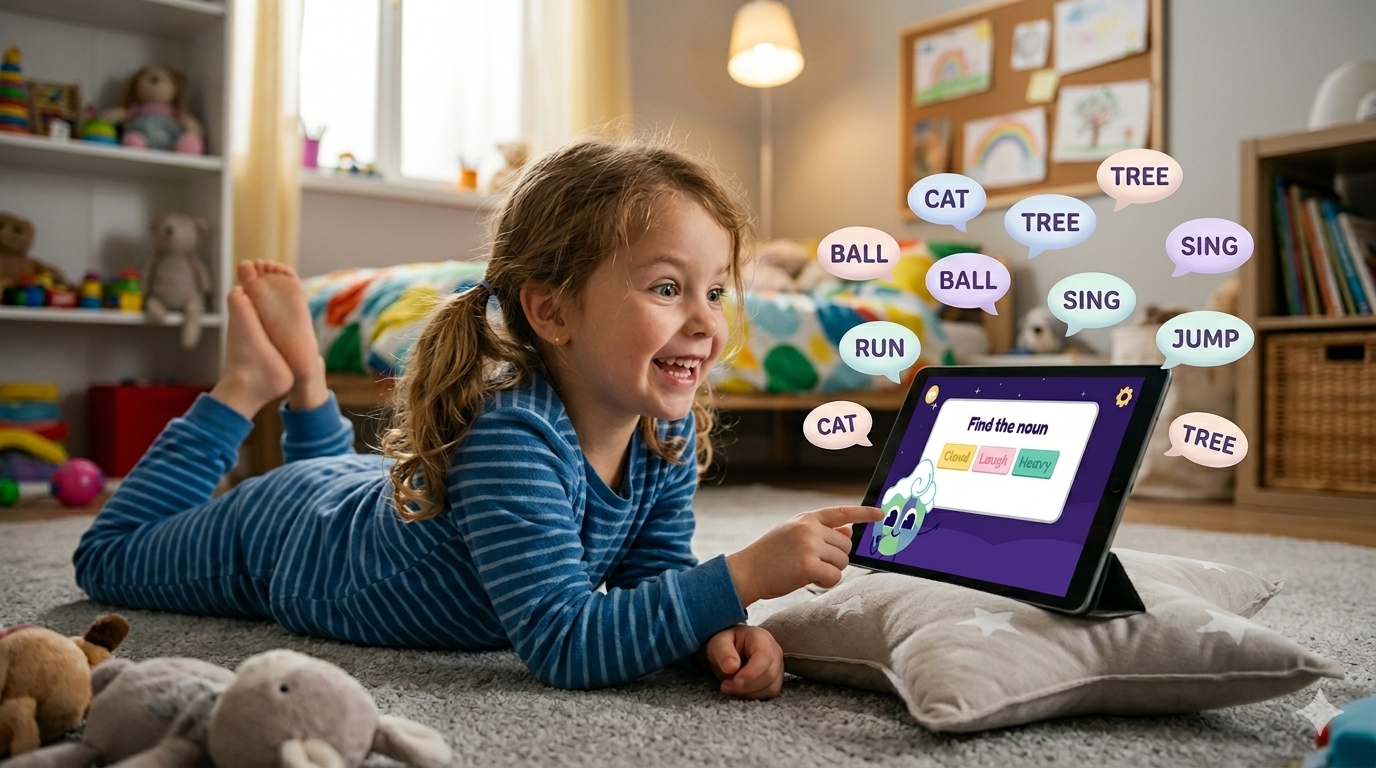
Parlini Land’s approach to nouns, adjectives, and verbs reflects exactly this developmental understanding. The games — Find the Noun, Find the Adjective, and Find the Verb — are built for children aged 5 and above, and they work through the same gentle, consistent mechanic across all three.
A series of words appears on screen. A real human voice — warm and clear, not synthetic — gives the child a prompt: find the noun, find the adjective, find the verb. The child taps their answer. If they tap the wrong word, they simply try again.
This matters more than it might seem. Children who are allowed to be wrong without consequence explore more freely. They try, observe the result, adjust, and try again — which is exactly how pattern recognition is built. A child who has played Find the Noun across a hundred sessions has encountered nouns in dozens of different sentences and contexts. They may not be able to recite a definition. But they will feel where the noun is, reliably, without thinking about it.
The games are calm by design. No flashing effects, no timer pressure, no competitive scoring. They sit alongside the wider Parlini Land games library — coloring, counting, matching, tracing — as part of a daily routine that feels like play rather than school. Grammar, introduced at exactly the right age, in exactly the right way.
What age should children learn nouns, adjectives, and verbs?
Children begin using nouns, adjectives, and verbs correctly in spoken language well before age 5, but conscious recognition of these categories is most developmentally appropriate from around age 5 onwards. At this stage, play-based exposure to the concepts — through games, reading, and conversation — is more effective than formal instruction.
What is the easiest part of speech for children to learn first?
Nouns are typically the easiest starting point, because they refer to concrete, visible things that children already know and name. Verbs come next, as children have a strong intuitive sense of actions. Adjectives are slightly more abstract but still accessible through describing familiar objects and animals.
How does Find the Noun work in Parlini Land?
A sentence or phrase appears on screen and a real human voice asks the child to tap the noun. If they tap the wrong word, the game invites them to try again without any negative feedback. The mechanic is the same for Find the Adjective and Find the Verb — simple, consistent, and designed to build recognition through repeated low-stakes practice.