
- by families worldwide
Every parent has experienced it. The moment learning feels like learning, the interest disappears. But the moment it connects to something a child already cares about — a favourite animal, a beloved character, a sport they cannot stop talking about — the walls come down. Thematic learning is the name for what is happening in those moments, and it is one of the most effective approaches in early childhood education.
Thematic learning — sometimes called theme-based learning or interest-led learning — is an approach that uses a central subject your child is already engaged with as the vehicle for teaching other concepts. Instead of presenting maths, shapes, and language as abstract subjects to be studied, thematic learning embeds them inside a context the child finds genuinely exciting.
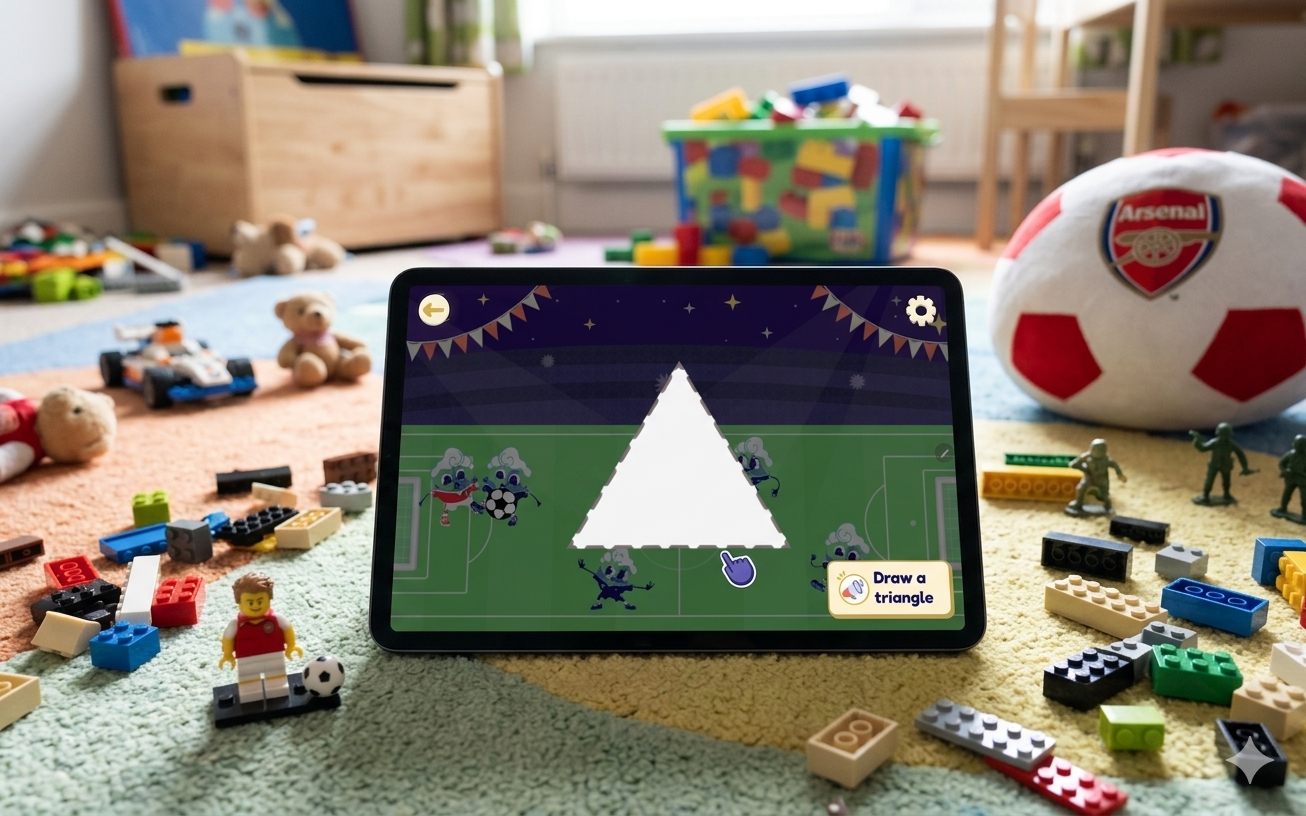
A football theme, for example, gives a child a reason to care about shapes. The circle of the ball. The rectangle of the goal. The lines on the pitch. These are not abstract geometric forms pulled from a textbook — they are part of a world the child already inhabits emotionally and imaginatively. When the context is motivating, the learning it contains becomes motivating too.
This is not a modern invention. Early childhood educators have been using children’s interests as learning scaffolds for decades. What has changed is our understanding of why it works — and the neuroscience is clear: when a child’s brain is engaged by something it finds rewarding, it is far more receptive to new information than when it is presented with content it finds neutral or difficult.
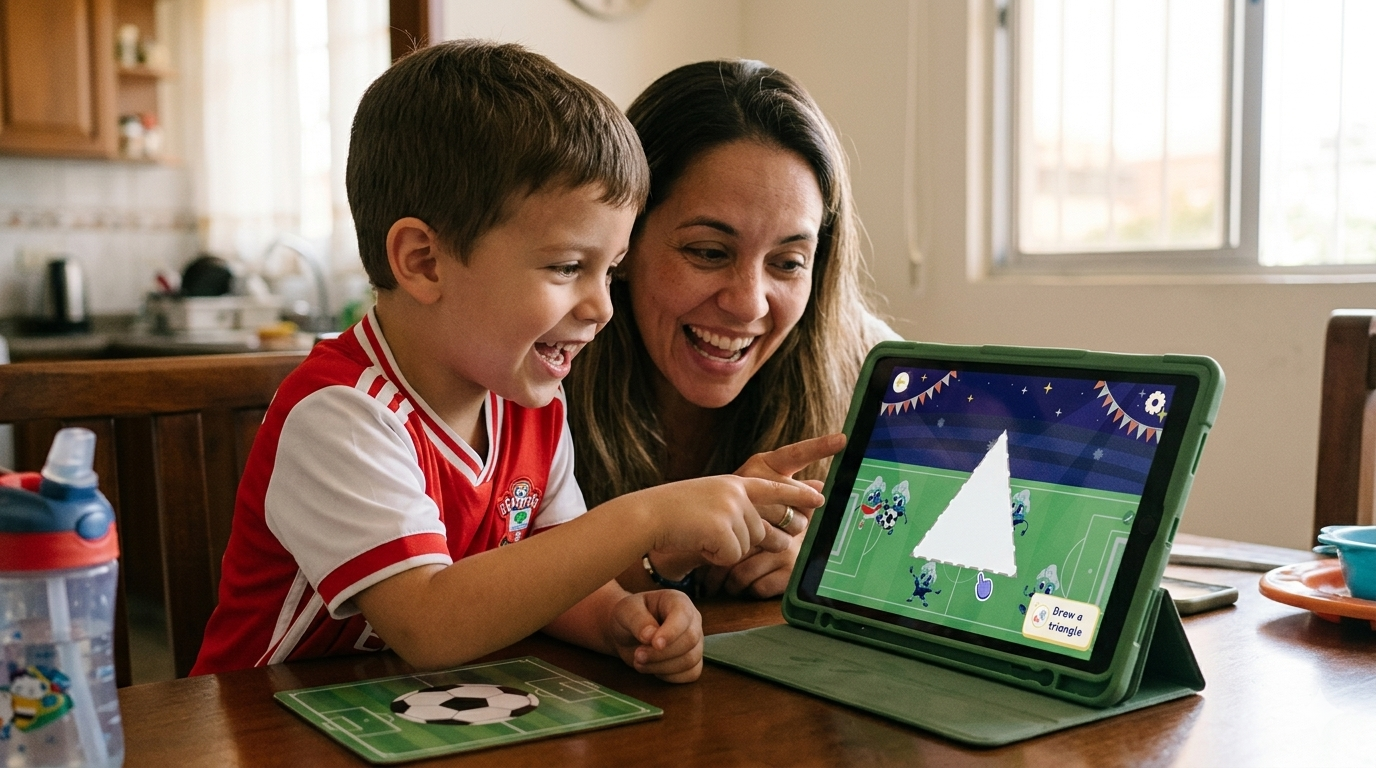
Football is one of the most universally recognised themes in children’s lives — across cultures, languages, and age groups. It appears in playgrounds, on screens, in conversations with parents and grandparents. For children who love it, it carries a level of emotional investment that few other themes match.
That emotional investment is exactly what makes it such a useful educational hook. When a child is playing a game where completing a shape allows their character to move down the football pitch, they are not thinking about shape recognition. They are thinking about scoring. The learning happens in the pursuit of the goal — literally.
Football also maps naturally onto several early learning concepts:
Shape and Goal is Parlini Land’s football-themed game, and it is one of the clearest examples of thematic learning done well — because the football is not a decoration on top of an educational activity. It is the engine that drives the whole experience.
Here is how it works: shapes appear on screen and the child is given a spoken command — “complete the circle,” for example — and must trace the shape with their finger. Each shape completed allows the Linis, the characters on the football pitch, to move closer to the goal. The child is not tracing shapes as an exercise. They are tracing shapes to score.
When the players reach the goal area, the child is given one final challenge — trace a line, a zigzag, or a curve — to complete the shot and score. The satisfaction of that goal is the reward that makes the whole sequence worth repeating.
Shape and Goal is available in all 11 of Parlini Land’s supported languages — English, Spanish, Greek, Irish, Hindi, Arabic, German, Italian, French, Swedish, and Polish — with real human voice prompts in each. This means the shape vocabulary, the commands, and the encouragement are all delivered in the child’s chosen language. Shape recognition, motor skill development, word and shape association, and language immersion all happen in the same game, because the football theme gives children a reason to keep going.
What is thematic learning for young children?
Thematic learning is an approach that uses a subject a child is already interested in — like football, animals, or space — as the context for teaching academic concepts like shapes, numbers, and language. Because the child is emotionally engaged with the theme, they are more receptive to the learning it contains.
Can football really be used to teach maths and shapes?
Yes. Football naturally involves shapes, spatial reasoning, and instruction-following — all of which are foundational to early maths and literacy. Games that embed shape recognition and language practice within a football context give children a motivating reason to engage with concepts they might otherwise find abstract.
What does Shape and Goal teach children?
Shape and Goal teaches shape recognition, develops fine motor skills through tracing, and builds word and shape association — all through a football-themed game where completing shapes moves players toward the goal. It is available in all 11 of Parlini Land’s supported languages, with real human voice prompts in each.