- by families worldwide
The best beginner German activities for young children are short, repeated, and built into everyday life. You do not need a curriculum. What you need are the same words, said in German, again and again, through play.
If you are raising a child in an English-speaking country and German is your heritage language, your partner’s language, or a language you are determined to keep alive, you will know the feeling. English is everywhere. It is in the cartoons, the nursery, the playground, and eventually the classroom.
German, unless you actively create space for it, gets squeezed out. The good news is that young children are wired for language. Between the ages of two and seven, they absorb sounds, rhythms and vocabulary at a rate they will never match again as adults. The window is open. The question is what to put through it.
Beginner activities do not need to be elaborate. In fact, the simpler they are, the more consistently you will use them, and consistency is the thing that matters most.
Not all language activities are created equal. When you are choosing resources for a beginner, here is what actually makes a difference.
When you are looking for a structured, screen-based activity that actually delivers German, not an English app with a German mode bolted on, Parlini Land is worth knowing about.
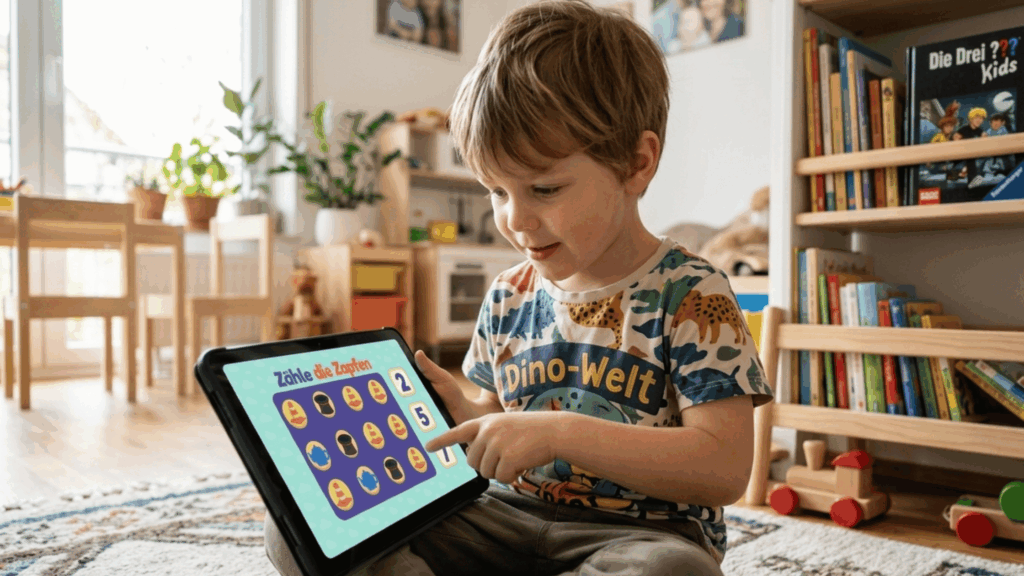
Every game prompt, every instruction, every word a child hears in Parlini Land is delivered in German. The app was built specifically for situations like yours: a heritage language that needs protecting in an English-dominant environment.
For beginners, some of the most useful games include Flashcards (scene-based images where children tap to hear the German word), This or That (listening and responding to German audio prompts), Colour (consisting of puzzle matching), and Sorting Boxes (matching items to colour categories, all in German). All voiceovers are real human recordings. The design is calm and low-stimulating. It does not try to compete with louder, flashier apps. It is teacher approved and designed for ages three to eight.
Find out more as you look through the full range of German learning games for kids.
You do not need to be fluent. Using simple, consistent words every day makes a real difference. Apps like Parlini Land can support pronunciation and vocabulary alongside what you already know. Even ten minutes a day of German-only input adds up significantly over months.
No. It is actually an ideal age. Children under seven are in a critical period for language acquisition. The earlier you introduce a language, the more natural it will feel. Simple, playful exposure at age two or three builds a foundation that formal learning later cannot replicate.
Keep it short. Two to five minutes of focused activity is often enough for a two or three year old. For four to six year olds, ten minutes is a reasonable target. Little and often beats long and occasional, especially with heritage languages where motivation can fluctuate.
Both work, but apps with audio give children something flashcards cannot: pronunciation. Hearing a real human voice say a word in German, repeatedly and in context, is closer to how children naturally acquire language. Physical flashcards are great for parent-led sessions; audio-first apps are useful for independent play time.
If you want a simple, low-pressure way to introduce German vocabulary through play, Parlini Land is a good place to start. So, we encourage you to download Parlini Land and give it a try.