- by families worldwide
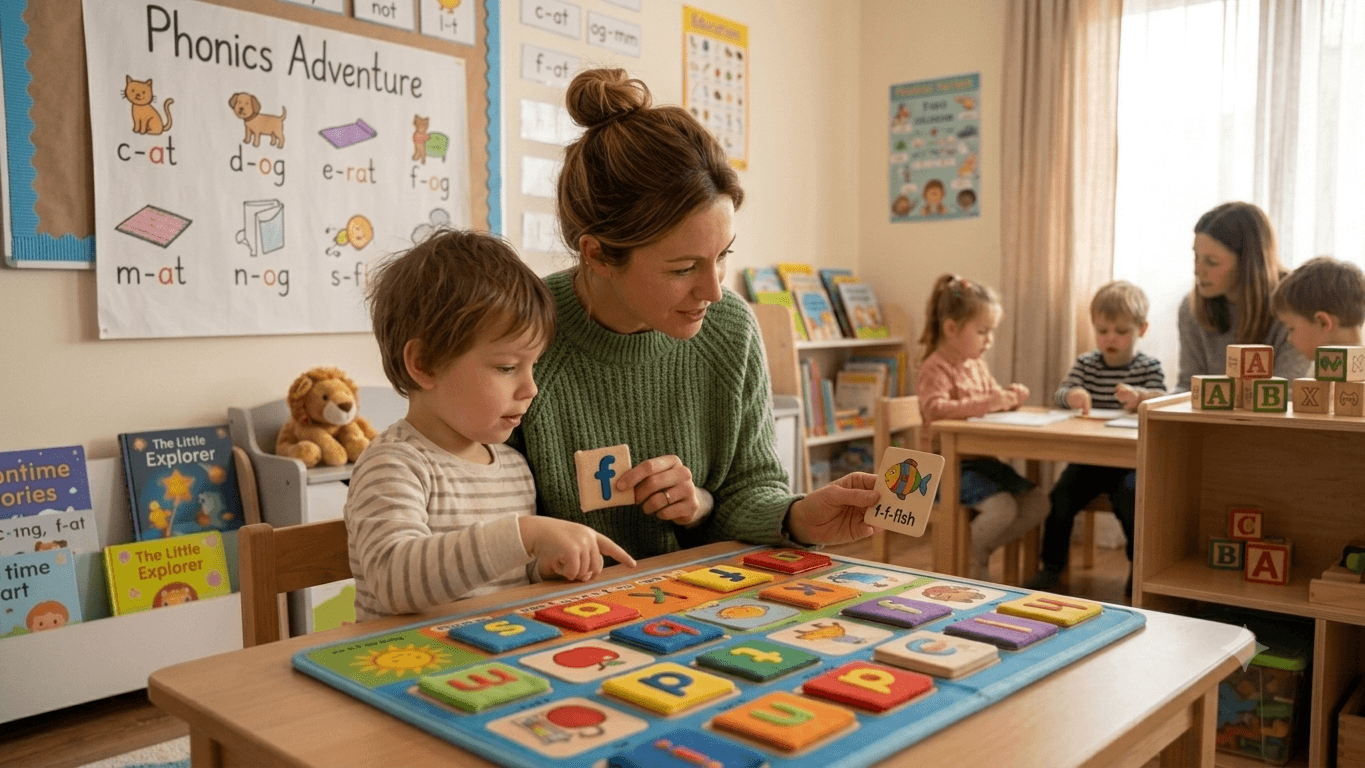
Before a child can read a single word, something else has to happen first. They need to be able to hear language — not just understand it, but hear the individual sounds inside it. The word cat is not just a word to a child who is ready to read. It is three sounds: c, a, t. That ability to pull apart and play with sounds is called phonemic awareness, and it is the single most reliable predictor of reading success. Most parents have never heard of it.
Phonemic awareness is the ability to hear, identify, and manipulate the individual sounds — called phonemes — within spoken words. It is entirely an auditory skill. It has nothing to do with letters on a page. A child can have strong phonemic awareness without being able to read a single word, and children who cannot yet read can develop it fully through listening and play.
Phonemes are the smallest units of sound in a language. The word ship has three phonemes: /sh/, /i/, /p/. The word black has four: /b/, /l/, /a/, /k/. Most words in everyday speech contain between two and six phonemes — sounds that fluent speakers process so automatically that they are invisible. For a child learning to read, making those sounds visible — or rather, audible and manipulable — is the first task.
Phonemic awareness is different from phonics, though the two are related. Phonics is the connection between sounds and written letters — the system that allows a child to decode a written word by sounding it out. Phonemic awareness is the auditory foundation that makes phonics possible. Without it, letters are shapes with no connection to the sounds of the language. With it, letters become a code — and codes can be cracked.
Decades of research in reading development have identified phonemic awareness as the strongest predictor of how easily a child will learn to read. Stronger than vocabulary. Stronger than general intelligence. Stronger than the amount of time a child has spent looking at books.
The reason is simple: reading in an alphabetic language is fundamentally a sound-to-symbol mapping task. Every letter or letter combination represents a sound. A child who can already hear and manipulate those sounds — who can tell you that cat starts with /k/, that dog rhymes with fog, that if you take the /s/ off snake you get nake — has already done most of the cognitive work that reading requires. The letters, when they arrive, slot into a framework that is already there.
A child who has not developed phonemic awareness arrives at letters with no framework to receive them. They may be able to memorise which shape goes with which name. But the deeper understanding — that letters represent sounds and sounds make words — does not click until the auditory foundation is in place. This is why some children seem to learn to read almost overnight, and others struggle despite effort and instruction. The difference is often phonemic awareness, built or not built in the years before formal reading begins.
The good news for parents is that phonemic awareness develops naturally through rich language exposure — and most of the things that support it are things families already do, or can easily do.
Reading aloud every day is the single most powerful thing a parent can do. Stories expose children to the rhythms and patterns of language in a way that conversation alone cannot. The repetition in picture books, the predictable rhymes, the repeated refrains — all of this builds phonological sensitivity without any deliberate teaching.
Rhymes and songs matter more than parents often realise. Nursery rhymes, playground songs, made-up nonsense poems — anything that draws a child’s attention to the sounds of language rather than just its meaning is building the auditory foundation that reading depends on.
Word games are quietly powerful. “What word rhymes with hat?” “What sound does a bird start with?” “Can you think of three words that begin with /m/?” These feel like games. To a developing brain, they are phonemic awareness training.
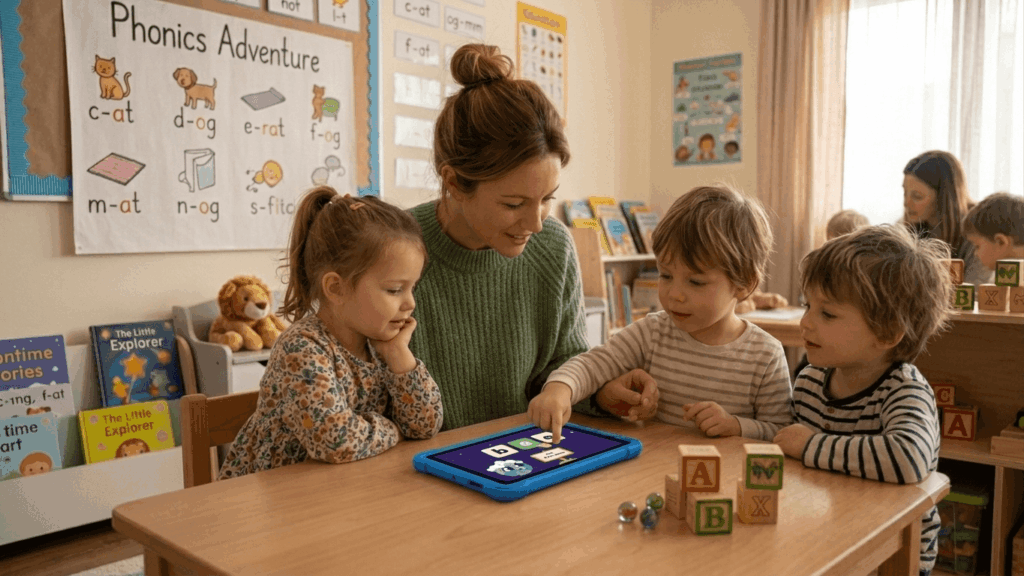
Listening to language in multiple contexts also helps — and this is where apps and audio tools become relevant. Any activity that asks a child to listen carefully to a spoken word and make a decision about its sounds is doing phonemic awareness work. The key is that the child is attending to the sounds of language, not just its meaning.
Bilingual children develop phonemic awareness in each of their languages — and the research on this is genuinely encouraging. Strong phonemic awareness in one language tends to support phonemic awareness development in the other, because the underlying cognitive skill — the ability to hear and manipulate sound units — transfers across languages even when the specific sounds differ.
This means that building phonemic awareness at home in a heritage or second language is not wasted effort, even if the child’s formal reading instruction happens in a different language. The auditory sensitivity your child develops in Spanish, Irish, Greek, or any other language builds the same cognitive foundation that English reading will later draw on.
For bilingual families, this is one of the more encouraging pieces of research in early literacy. Time spent on the heritage language is not time taken away from English literacy development. The two reinforce each other at the level of foundational skills, even when the surface sounds are completely different.
Parlini Land’s approach to early literacy is built around exactly the kind of listening-led, low-pressure exposure that phonemic awareness development requires.
Games like Hear and Tap the Letter and Tap on the Vowel ask children to listen carefully to spoken prompts and make decisions about sounds — identifying a letter sound, locating a vowel in a word, and distinguishing between similar-sounding letters. These are not reading exercises. They are auditory exercises that build the sound-symbol connections phonemic awareness makes possible.
Before a child can read a single word, something else has to happen first. They need to be able to hear language — not just understand it, but hear the individual sounds inside it. The word cat is not just a word to a child who is ready to read. It is three sounds: c, a, t. That ability to pull apart and play with sounds is called phonemic awareness, and it is the single most reliable predictor of reading success. Most parents have never heard of it.
Phonemic awareness is the ability to hear, identify, and manipulate the individual sounds — called phonemes — within spoken words. It is entirely an auditory skill. It has nothing to do with letters on a page. A child can have strong phonemic awareness without being able to read a single word, and children who cannot yet read can develop it fully through listening and play.
Phonemes are the smallest units of sound in a language. The word ship has three phonemes: /sh/, /i/, /p/. The word black has four: /b/, /l/, /a/, /k/. Most words in everyday speech contain between two and six phonemes — sounds that fluent speakers process so automatically that they are invisible. For a child learning to read, making those sounds visible — or rather, audible and manipulable — is the first task.
Phonemic awareness is different from phonics, though the two are related. Phonics is the connection between sounds and written letters — the system that allows a child to decode a written word by sounding it out. Phonemic awareness is the auditory foundation that makes phonics possible. Without it, letters are shapes with no connection to the sounds of the language. With it, letters become a code — and codes can be cracked.
The Uppercase or Lowercase game also contributes to this, because every round begins with a spoken letter name — a real human voice delivering a clear, natural prompt before the child does anything visual. The habit of listening first, then seeing, then deciding is itself a phonemic awareness habit: the prioritisation of sound as the entry point to written language.
All of Parlini Land’s literacy games use real human voiceovers — not synthetic audio — across all eleven supported languages. This matters for phonemic awareness development because children’s brains are calibrated to the specific sounds of human voices. Authentic pronunciation, natural rhythm, and genuine vocal warmth are not just nice to have. They are what makes the auditory input land in a way that builds real phonological knowledge, in whichever language your child is developing.
What is phonemic awareness in children?
Phonemic awareness is the ability to hear, identify, and manipulate individual sounds — called phonemes — within spoken words. It is an entirely auditory skill that develops before reading begins and forms the foundation that allows children to decode written language. It is consistently identified as the strongest predictor of early reading success.
What is the difference between phonemic awareness and phonics?
Phonemic awareness is auditory — it is the ability to hear and manipulate sounds in spoken words. Phonics is the connection between those sounds and written letters. Phonemic awareness is the foundation that makes phonics possible: a child who can already hear and play with the sounds in a word will find the letter-sound mappings of phonics much easier to learn.
At what age should children develop phonemic awareness?
Phonemic awareness develops gradually from birth through early childhood, with the most significant development typically occurring between ages 3 and 6. Children who have had rich oral language exposure — through reading aloud, songs, rhymes, and word play — generally arrive at school with a strong phonemic awareness foundation that makes formal reading instruction much more effective.