- by families worldwide

There’s a moment most parents hit somewhere around week three. You’ve been naming things in French. You’ve been patient. And your child looks up at you and says, in perfect English, “I don’t want to do French.”
Here’s the thing: they weren’t objecting to French. They were objecting to being tested.
That’s the whole reason games work. A game has a goal that isn’t say this word correctly. The goal is to win, to find the hidden thing, to be faster than your brother. The French is just how you get there — so your child stops monitoring themselves and starts producing language without noticing they’re doing it.
Below are 15 games for ages 3–6, plus a bonus set for 5s and up. Every one includes the actual French you’ll need, with pronunciation, so you can play these tonight even if your own French stopped at GCSE.
Worth setting expectations, because the gap between what parents expect and what’s normal causes a lot of unnecessary worry.
Speaking arrives in three stages, and they don’t overlap the way you’d think:
If your child is at stage one after a month, nothing has gone wrong. Stage one is the work. More on the timeline in starting French early for bilingual kids.
Learn these five and you can run this entire list.
French | Meaning | Say it like |
Touche le / la… | Touch the… | toosh |
Où est…? | Where is…? | oo EH |
Regarde ! | Look! | ruh-GARD |
Combien ? | How many? | kom-BYAN |
Encore ! | Again! | on-KOR |
And for praise: Bravo ! — which, unlike Italian or Spanish, doesn’t change for boys or girls. One less thing to think about.
There’s a specific problem screen games solve, and it isn’t keeping children busy. It’s this: if you don’t speak French confidently, you can’t be your child’s only source of it. Your accent becomes their accent, and the gaps in your vocabulary become the ceiling on theirs.
French makes this sharper than most languages, because of liaison — the way words run into each other. Dix ans is “dee-ZAHN,” not “dees ahn.” No amount of reading gets you that.
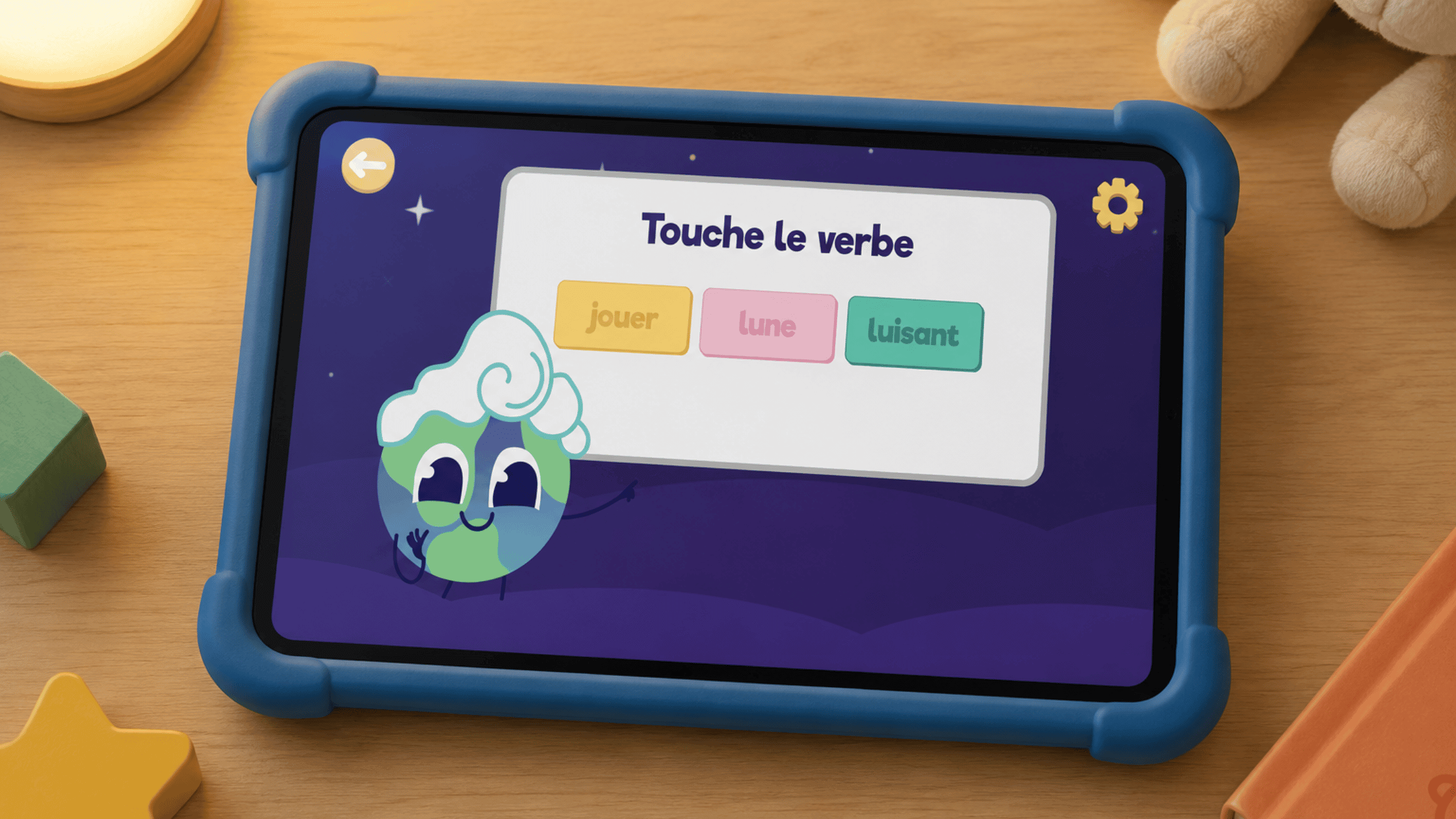
That’s the gap Parlini Land fills. Every prompt is recorded by a real French speaker — no AI voices — so your child hears French as it’s actually spoken. The design is deliberately calm and low-stimulation, which means it doesn’t leave a three-year-old wired at 6pm.
More on how the games work together: learn French through kids’ games.
Two things change around five, and both change what kind of game works.
They’re starting to read. Which means letters, spelling and word types suddenly become available — and those are the tools that lock vocabulary into long-term memory rather than leaving it as sounds they half-recognise.
They’ve become self-conscious. A four-year-old doesn’t mind being wrong. A six-year-old minds a lot, especially in front of a younger sibling who’s better at French. Games with clear rules and a chance to win work beautifully. Adults correcting their accent does not.
Le petit bac — the French classic, and the best of the lot. Pick a letter, then everyone races to fill in a prénom (first name), animal, ville (town), couleur and métier (job) starting with it. Points for anything nobody else got. French children play this on every long car journey, and it works because the competition, not the vocabulary, is what your child is thinking about.
Devine à quoi je pense (Guess what I’m thinking) — twenty questions, French only. Your child has to form questions rather than answer them, which is the harder and more valuable skill: C’est un animal ?, C’est grand ?, Ça se mange ? (sah suh MAHNZH — can you eat it?).
Je suis allé au marché — the cumulative memory game. Je suis allé au marché et j’ai acheté du pain… and each player adds an item while repeating the whole list.
Cartoons with French subtitles on — not a game, but the highest-value change you can make at this age. Once they can read, matching written French to spoken French happens automatically and costs you nothing.

Uppercase vs lowercase — tap the matching letter form. Sounds basic; it’s the pre-reading skill that makes French books possible, and it’s the one most children skip past too fast.
Spelling Games — three modes, progressively harder: complete the word, find the missing letter, add the right letter. This is what turns French your child hears into French they can read and write.
Find the Noun, Find the Verb, Find the Adjective — three separate games, same format: three French words appear and your child picks the one that belongs to that word class. This is the jump from knowing words to knowing what kind of word they are. It also front-runs school, where they’ll meet these as le nom, le verbe and l’adjectif.
Find the Vowels — a word appears and your child finds the vowels inside it. This one matters more in French than in most languages. French has six vowels rather than five — a, e, i, o, u and y — and then layers accents on top: é, è, ê, à, ù. Vowels are where French spelling gets decided, so a child who can find them confidently has the hardest part of French reading already in hand.
All of it in real recorded French, no AI voices — which matters more at six than at three, because this is the age your child starts noticing when something sounds wrong.
They will. Constantly. Here’s what helps:
Don’t correct — recast. They say “cat!” You say oui, le chat ! and carry on. No pause, no “in French, please.”
Accept mixed sentences as wins. “Look, un chien!” is not a failed French sentence. It’s a child reaching into two languages at once, which is exactly what bilingual children do.
Never make French the price of something they want. The moment French becomes a toll gate, it becomes a chore.
Stop before they want to. Four good minutes beats fifteen that ended in a negotiation. Ending on encore ? — asked by them, not you — is the whole goal.
Less than you think, but you do need to be relaxed about being imperfect. Children copy your attitude to a language far more reliably than they copy your grammar. A parent who cheerfully mangles grenouille and laughs about it teaches something more useful than a parent who avoids French for fear of getting it wrong.
If you’d rather build from the ground up than pick games at random, start with how to teach French to kids at home, or grab the easy first French words to play these games with.
Pick three games from this list. Not fifteen. Run those three for two weeks until they’re automatic, then swap one out. The families who keep this going aren’t the ones who did the most — they’re the ones who did the same small thing often enough that it stopped being a decision.
Parlini Land is available on the App Store and Google Play, with games in Italian and 10 other languages. Monthly, annual and lifetime plans available. Download Parlini Land today.