
- by families worldwide
Football apps for children are everywhere. Most of them do one thing well — they are fun. What they rarely do is anything else. For parents who want their child’s screen time to count for something beyond entertainment, the question is not which football app is the most fun. It is which one is worth the time? Here is how to think about that — and what a genuinely educational football app looks like.
The majority of football apps designed for young children fall into one of two categories. The first is the pure entertainment category — fast-paced, reward-heavy, high stimulation. These apps are designed to maximise engagement time, not learning. They are good at keeping children occupied and not much else.
The second category tries to add educational value but does so superficially — a maths problem before you can take a penalty, a spelling quiz between matches. The football is the reward for doing the education, which means the two are kept deliberately separate in the child’s experience. This is not thematic learning. It is incentivised drilling.
The rarest category is the one worth finding: an app where the educational content is not separate from or rewarded by the football experience, but is built into the core of how the game works, where the learning is how you play, not what you do to earn the right to play.
These are the qualities that separate a genuinely educational football app from one that is just using “educational” as a marketing word:
Shape and Goal is Parlini Land’s football-themed game, and it is one of the few children’s football apps that meets all of the criteria above — not because it was retrofitted to do so, but because it was designed with them in mind from the start.
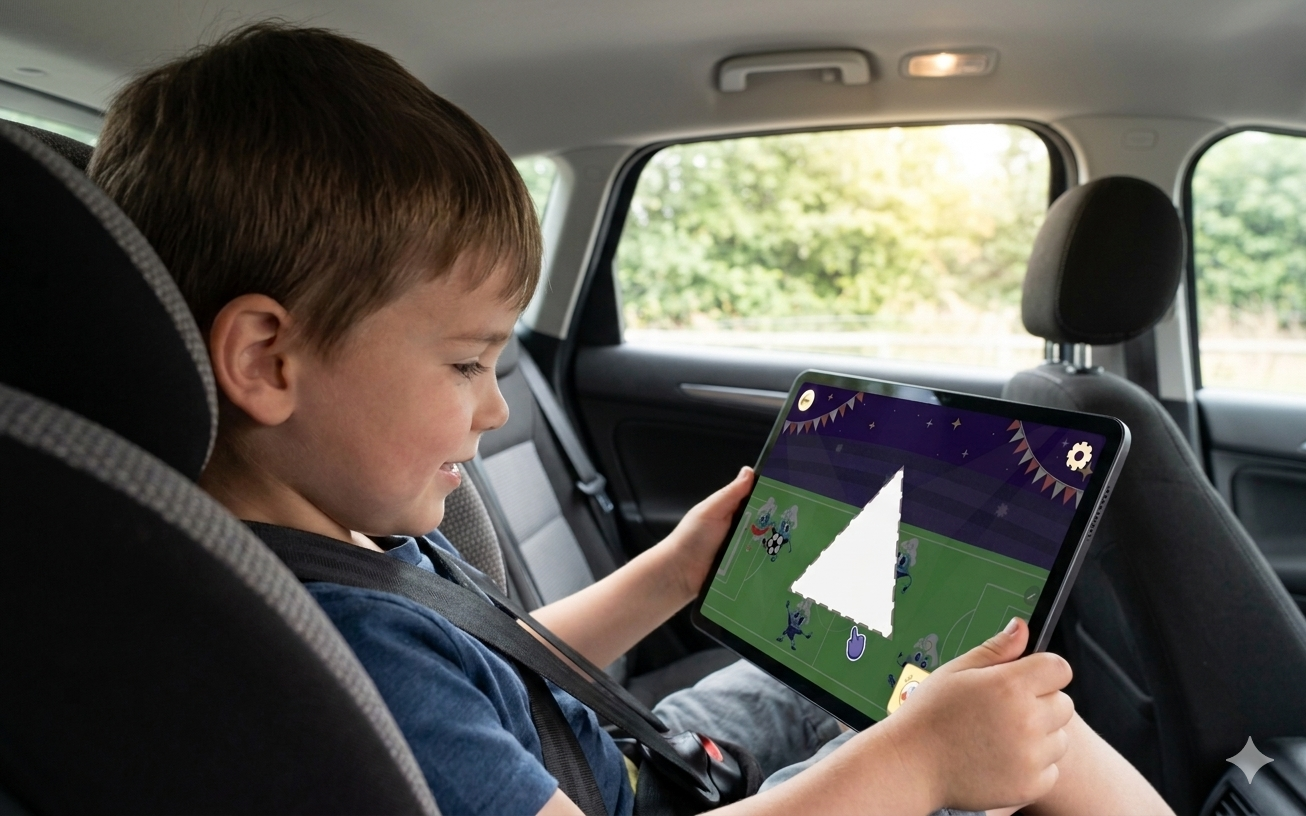
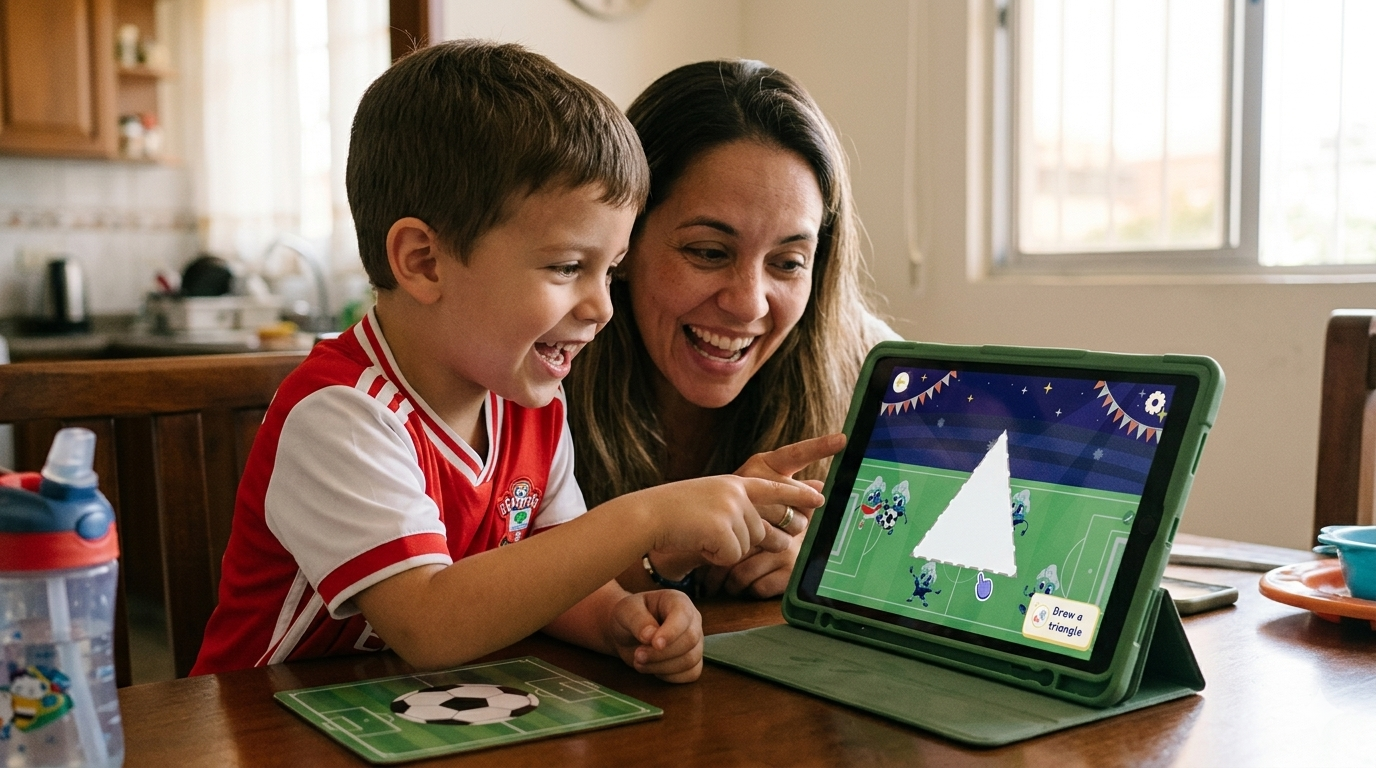
The game places children on a football pitch with the Linis — the characters who advance toward goal as shapes are completed. A real human voice delivers a command: “complete the circle,” “trace the zigzag,” “draw a straight line.” The child traces the shape on screen. The player moves. Eventually, the goal area is reached and one final trace — whatever the voice commands — sends the ball into the net.
In a single session, a child has practised shape recognition across multiple forms, developed fine motor control through traced lines and curves, built word-shape association by hearing and acting on spoken commands, and done all of it within an experience that felt like a football game. There is no educational section and fun section. They are the same section.
Shape and Goal is available in all 11 of Parlini Land’s supported languages — English, Spanish, Greek, Irish, Hindi, Arabic, German, Italian, French, Swedish, and Polish — with native human voiceovers in each. For families raising children with a language other than English, this is not a minor feature. It is the difference between an app that supports their child’s development and one that does not.
What makes a football app educational for young children?
An educational football app embeds learning into the gameplay itself — not as a separate section or a reward for playing. The best examples use the football context to deliver shape recognition, language vocabulary, fine motor development, and listening skills through the mechanics of the game, so children are learning through the act of playing rather than pausing to study.
What does Shape and Goal teach children?
Shape and Goal teaches shape recognition across multiple forms — circles, lines, zigzags, curves, rectangles — develops fine motor skills through tracing mechanics, and builds word and shape association through spoken commands from real human voices. It is available in all 11 of Parlini Land’s supported languages.
Is Shape and Goal suitable for very young children?
Yes. The tracing mechanic and shape recognition elements are accessible from around age 3, and the spoken command format means children do not need to be able to read to play. As children’s language and cognitive skills develop, the game’s language and shape elements become progressively more meaningful.