- by families worldwide

Colours are the fastest early win in Italian, and colour games for kids are where most families should start. It’s worth understanding why, because the reason tells you how to teach them.
Numbers need a sequence held in memory. Animals need a picture or a zoo. Colours need nothing. They’re already in the room, on the plate, on the jumper your child is refusing to wear. There’s no setup, no props, and no waiting for the right moment. Every single thing your child looks at today is an opportunity to say a colour word out loud.
Which means colours are the vocabulary set where frequency does the work for you and frequency, not intensity, is what makes words stick at three and four years old.
Colour | Italian | Say it like |
red | rosso | ROS-soh |
blue | blu | bloo |
yellow | giallo | JAL-loh |
green | verde | VER-deh |
orange | arancione | ah-ran-CHOH-neh |
purple | viola | vee-OH-lah |
pink | rosa | ROH-zah |
brown | marrone | mar-ROH-neh |
black | nero | NEH-roh |
white | bianco | BYAN-koh |
grey | grigio | GREE-joh |
Three sounds to get right:
Start with four, not eleven. Rosso, blu, giallo, verde. These four cover most of a small child’s world and they sound nothing like each other, which matters more than you’d think, words that sound similar get learned slower when taught together.
Italian colour words change their ending depending on what they’re describing. Il libro rosso (the red book) but la palla rossa (the red ball). Plural: i libri rossi, le palle rosse.
Do not teach this. Do not correct it. A four-year-old saying palla rosso is producing Italian, and the ending will sort itself out through exposure the way it does for children in Italy, who also say it wrong for a couple of years.
The one useful thing to know: blu, rosa and viola don’t change at all, regardless of what they’re describing. So if you want easy wins where your child can’t get the ending wrong, those three are free.
Clean washing, one pile per colour. Hold up an item, say the colour, your child throws it on the right pile. Then reverse it, they hold up, you name.
It’s the single best colour game there is and it isn’t really a game, which is exactly why it survives past week two.
Keh koh-LOH-reh eh.
The only question you need. Ask it about the bus, the front door, the dog, the sky, the yoghurt. Six times a day, in passing, with no expectation of an answer at first.
When they don’t answer, answer it yourself and move on. That’s not a failed attempt, that’s the exposure doing its job.
Name a colour and set a timer. Your child runs around the house collecting everything they can find in that colour. Count the haul at the end, in Italian, if you’ve got numbers going too (here’s the numbers guide).
Colour of the day. Announce it at breakfast, oggi è il giorno rosso (today is red day). Wear something red, eat something red, point out everything red you see until bedtime.
Why it works: one word, all day, in dozens of unrelated contexts. That’s how a word moves from “recognised” to “owned.”
Berries, peppers, Smarties, anything multicoloured. Sort before eating. Name each colour as it moves. Eat the pile they can name.
Verde — run.
Giallo — walk slowly.
Rosso — stop.
Whole-body, high-energy, and it needs nothing but a garden or a hallway. Works with two children better than one, if you have them.
Lego, Duplo, wooden blocks. Build a tower where every layer is one colour, naming as you go. Or: dammi un mattoncino verde (give me a green brick) and build together.
The lowest-energy option, for the end of a long day. Colour a picture together and narrate what you’re picking up: ora il giallo… adesso il verde. No questions asked of your child at all, they just listen while their hands are busy.
Vuoi la maglietta blu o la maglietta rossa? — do you want the blue t-shirt or the red one?
A forced choice between two named colours, at a moment when your child badly wants to express a preference. Motivation is doing the teaching here, not you.
Two Parlini Land games target colour vocabulary in Italian directly, and they work on the two different skills that colour learning actually splits into.
Sorting Boxes — three coloured boxes appear with three objects, and your child matches each object to the right box. This is categorisation: understanding that a red ball and a red car share a property. It’s the underlying concept that makes the colour word mean something rather than just label one object.
The colour monster puzzle — a colour monster appears and your child matches it to the correct puzzle piece. Faster, more playful, and it drills recognition speed. This is the one they’ll ask to play again.
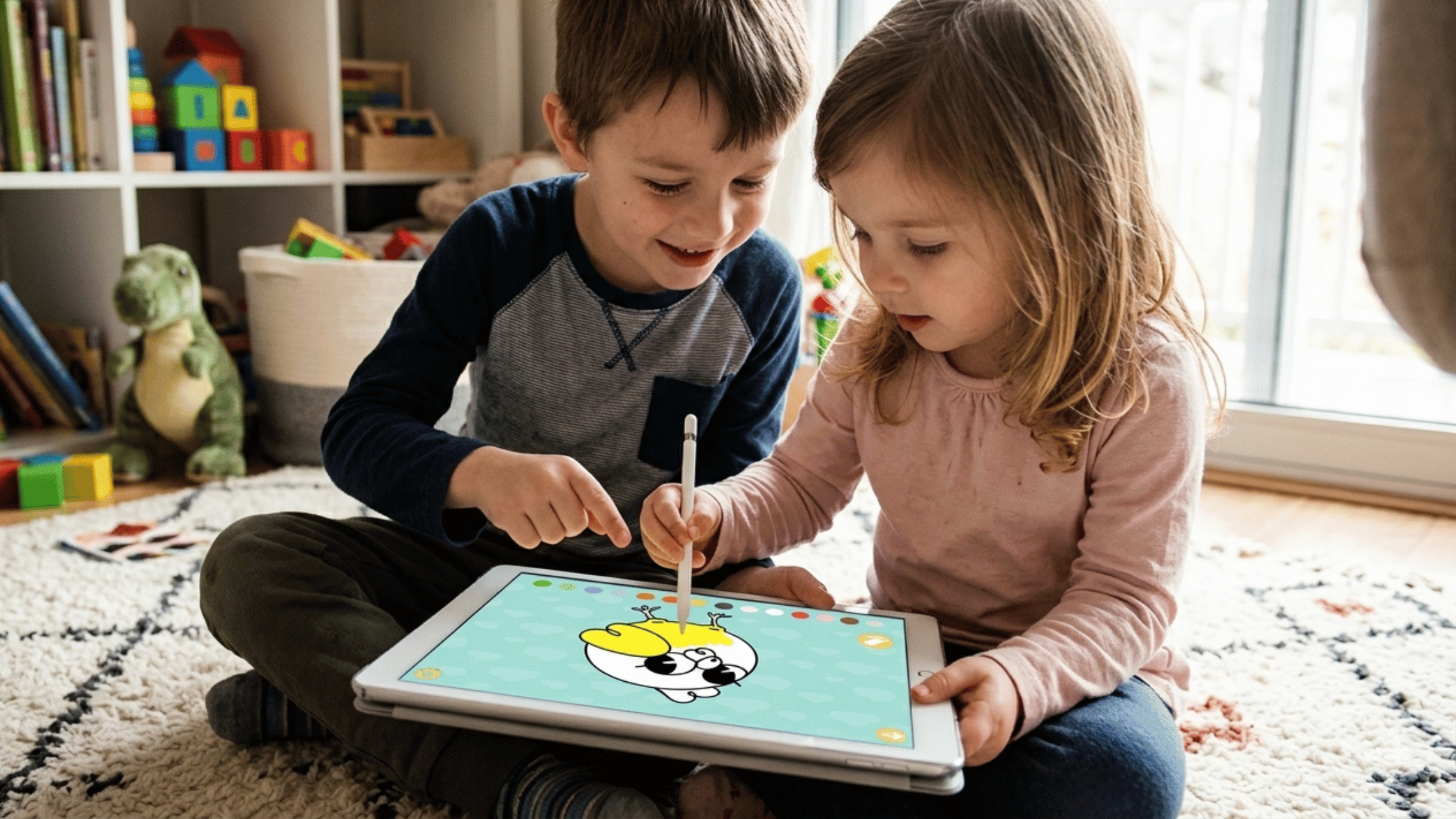
There’s also the Colour game, where your child colours in animal outlines and hears the animal’s name in Italian — so you’re getting colour practice and animal vocabulary in the same activity.
All prompts and voiceovers are recorded by real Italian speakers, not AI, and the whole app is built to be calm and low-stimulation rather than loud and reward-flooded. If you’re using screen time for language on purpose, it should sound like the language and it shouldn’t leave your child wound up.
More on how the games work together: learn Italian through kids’ games. And if you want games that go beyond colours, here are more Italian games for kids covering animals, numbers and everyday objects.
Teaching all eleven at once. A colour chart with every colour on it looks productive and teaches almost nothing. Four colours, held for two or three weeks, then add two more. Children need a word to come back around many times before it’s theirs.
Turning che colore è? into an exam. If your child hesitates and you wait, eyebrows up, for an answer, you’ve made it a test. Ask, pause briefly, answer it yourself, carry on. The pressure is what makes children go quiet in a second language, and it’s completely avoidable. More on that here.
In roughly this order:
Step five is where colours stop being a list and start being language. Getting the ending wrong is a sign of progress, not a gap, it means your child is building sentences rather than reciting words.
Just starting out with Italian generally? Begin here: where do I begin teaching my preschooler Italian.
Parlini Land is available on the App Store and Google Play, with colour games in Italian and 10 other languages. Monthly, annual and lifetime plans available. Download Parlini Land today.