
- by families worldwide
If you’re going to start your child on French somewhere, start with numbers.
Compare that to animals, or food, or feelings, where the list never ends and neither you nor your child ever gets the satisfaction of finishing anything.
Numbers also come with something no other vocabulary set has: a built-in reason to say them out loud, dozens of times a day, without anyone having to invent one. Stairs. Grapes. Seconds before a race. The repetition is already in your day, you’re just changing the language it happens in.
French numbers are the point where most English-speaking parents lose confidence, because almost none of them are pronounced the way they look. Print this or screenshot it.
Number | French | Say it like |
1 | un | uhn (nasal) |
2 | deux | duh |
3 | trois | twah |
4 | quatre | KAT-ruh |
5 | cinq | sank |
6 | six | seess |
7 | sept | set |
8 | huit | weet |
9 | neuf | nuhf |
10 | dix | deess |
11 | onze | onz |
12 | douze | dooz |
13 | treize | trez |
14 | quatorze | kah-TORZ |
15 | quinze | kanz |
16 | seize | sez |
17 | dix-sept | dee-SET |
18 | dix-huit | dee-ZWEET |
19 | dix-neuf | deez-NUHF |
20 | vingt | van (nasal) |
Four things to get right, because they’re the ones English speakers reliably miss:
If that list looks intimidating, this is exactly what the Number Soundboard in Parlini Land is for: tap any number from 1 to 20 and hear it in real recorded French. You don’t have to be the one pronouncing it.
Most children stall at ten. Here’s the good news about French, and it’s genuinely good news.
From 11 to 16, the numbers are single words that just have to be learned: onze, douze, treize, quatorze, quinze, seize.
There’s no pattern to spot. Six words, learned like any other six words.
But at 17, French gets lazy in your favour. It stops inventing new words and just glues ten onto the front:
So the moment your child knows one to ten, they’ve already got 17, 18 and 19 for free. Point this out to a five-year-old and watch their face, children love a shortcut, and this one is real.
And the thing you’ve heard is hard? Ignore it for now.
You may have heard that French numbers go strange later: 70 is soixante-dix (sixty-ten), 80 is quatre-vingts (four-twenties), 90 is quatre-vingt-dix (four-twenty-ten). It’s true and it’s odd.
It’s also completely irrelevant to a five-year-old. Nobody needs 70 before they own 20. And worth knowing: Belgian and Swiss French use septante and nonante instead, which are perfectly normal French — so even the hard part has an easy version out there.
Ranges, not rules. Children move at wildly different speeds and none of it predicts anything later.
One number per step, every time you go up. Un, deux, trois… Coming down, count backwards. It takes no extra time and it happens ten times a day.
Highest-return activity on this list, and the one parents most often skip because it doesn’t feel like teaching.
Grapes, blueberries, crackers. Count them onto the plate together, then ask combien ? (kom-BYAN — how many?) and count again.
Eating one and recounting is, to a three-year-old, the funniest thing that has ever happened.
Every countdown becomes French. Before a jump, a race, a slide, throwing a ball. Partez (par-TAY) means “go.”
Pile up blocks or toy cars. Donne-moi trois voitures — give me three cars (don-MWAH). They hand them over, counting as they go.
Why it works: two skills at once, comprehension and counting, but only one of them feels like the task.
Fingers, toes, ears, noses. Combien de doigts ? (how many fingers — dwah). Nothing to fetch, which makes this the game for the ten minutes before bed.
6. Le jeu du dé (The dice game)
Roll a die, say the number in French, move that many spaces on any board game you already own. Two dice when they’re ready — and now they’re adding in French, which is the real point.
Write 1 to 10 on paper scraps, hide them around a room, and your child finds them and puts them in order. Call où est le sept ? to send them after a specific one.
Prends cinq pommes — take five apples. Counting into a bag, in French, in public, with a purpose. Children take this job extremely seriously.
Dix, neuf, huit… before anything dramatic — a rocket launch, jumping into a pool, turning out the lights. Counting backwards is much harder than forwards, and this is the only painless way to practise it.
The French equivalent of “eeny meeny miny moe” — the traditional rhyme French children use to decide who goes first. Ask any French speaker to say it once and you’ll have it. It’s nonsense, it’s rhythmic, and it gets used for real decisions dozens of times a week rather than for practice.
Worth pairing with Un, deux, trois, nous irons au bois, the classic French counting rhyme that runs all the way to twelve.
Numbers are the one area where repetition genuinely matters — and repetition is exactly what children will accept endlessly from a game and refuse instantly from a parent.
Four parts of Parlini Land cover numbers in French:
Number Soundboard — tap any number from 1 to 20 and hear it in real French. This is the reference tool, not a game, and it’s the one that solves the parent problem rather than the child problem. You’ll use it as much as they do.
Trace the Numbers — your child traces each numeral with their finger while hearing it named in French. This links the written symbol to the French word, which is the connection that makes maths in French possible later.
Order the Numbers — sequencing, biggest to smallest and back. This is the game that exposes the child who’s memorised the sound of counting without understanding the order, which is far more common at four than parents expect.
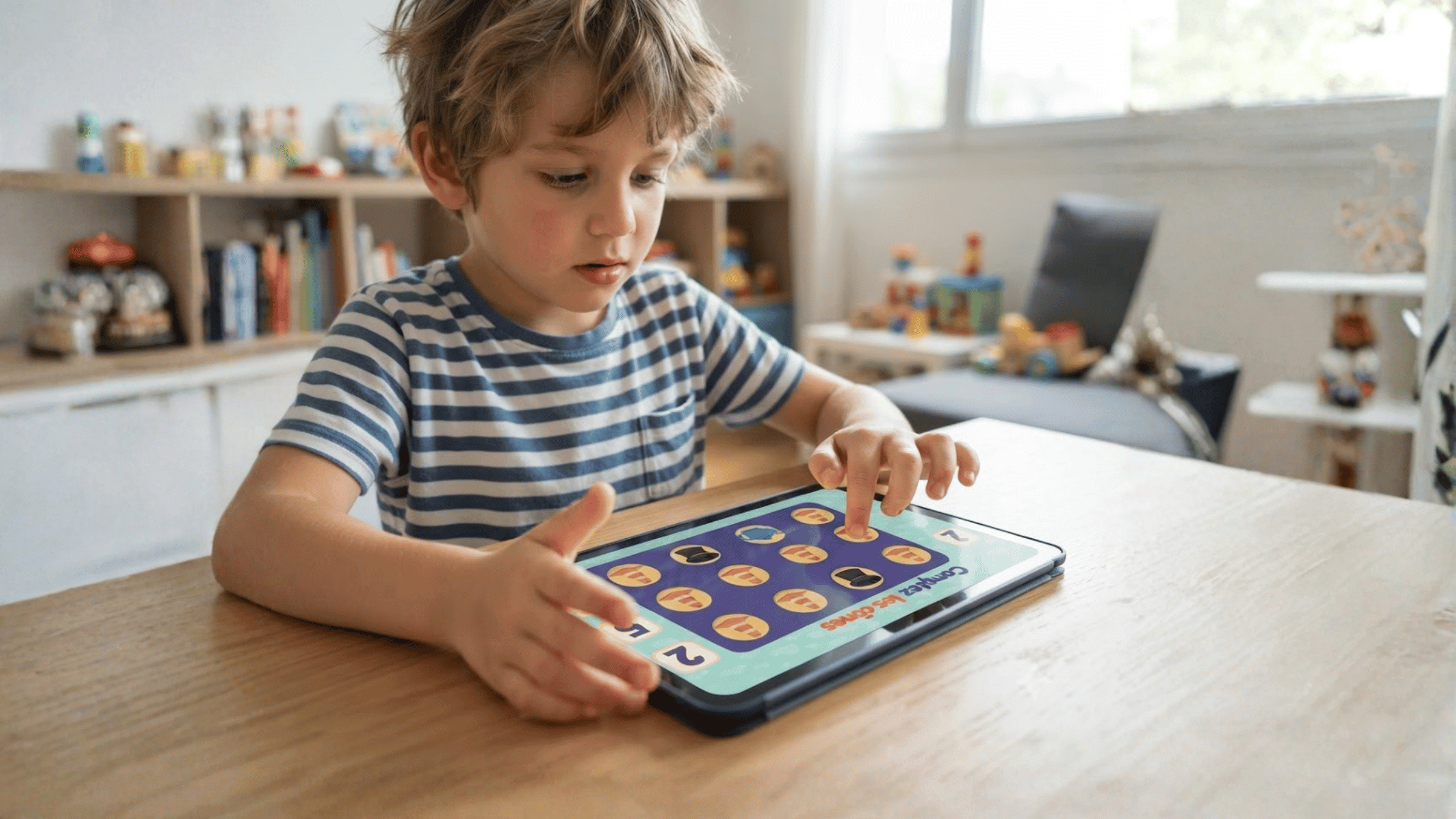
Can You Count — a voice asks how many, and your child taps to count what’s on screen. Counting objects that don’t stay still is meaningfully harder than counting grapes on a plate, and it’s the step that turns recitation into actual counting.
Every prompt is voiced by a real French speaker — no AI voices — so the numbers your child learns are the numbers they’ll recognise in a French classroom or from a French-speaking relative. The design is deliberately calm, so this isn’t a game that leaves a four-year-old overstimulated.
See how it fits with the rest: learn French through kids’ games.
“They can recite to ten but can’t count five objects.” Completely normal, and it isn’t a French problem — it’s a counting problem showing up in French. Recitation is a song; counting is a one-to-one mapping. Go back to counting things they can physically move, one at a time, from one pile to another.
“They mix up six and dix.” Almost universal, because in French they rhyme — “seess” and “deess.” Separate them for a week: play games that use six and not ten, then swap, then put them back together.
“They refuse to count in French and switch to English.” Don’t make them start again. Count alongside them in French while they count in English — the two tracks running at once does more than any correction. And check whether the counting has quietly become a test rather than a game. That’s usually what’s happened.
Signs you’re getting somewhere, roughly in order:
Number four is the big one. It looks like a mistake, and it’s actually the moment the word stopped being a performance and became a word they own.
Just getting started with French generally? Begin with how to teach French to kids at home, or see why starting early matters.
Parlini Land is available on the App Store and Google Play, with number games in French and 10 other languages. Monthly, annual and lifetime plans available. Download Parlini Land today.